
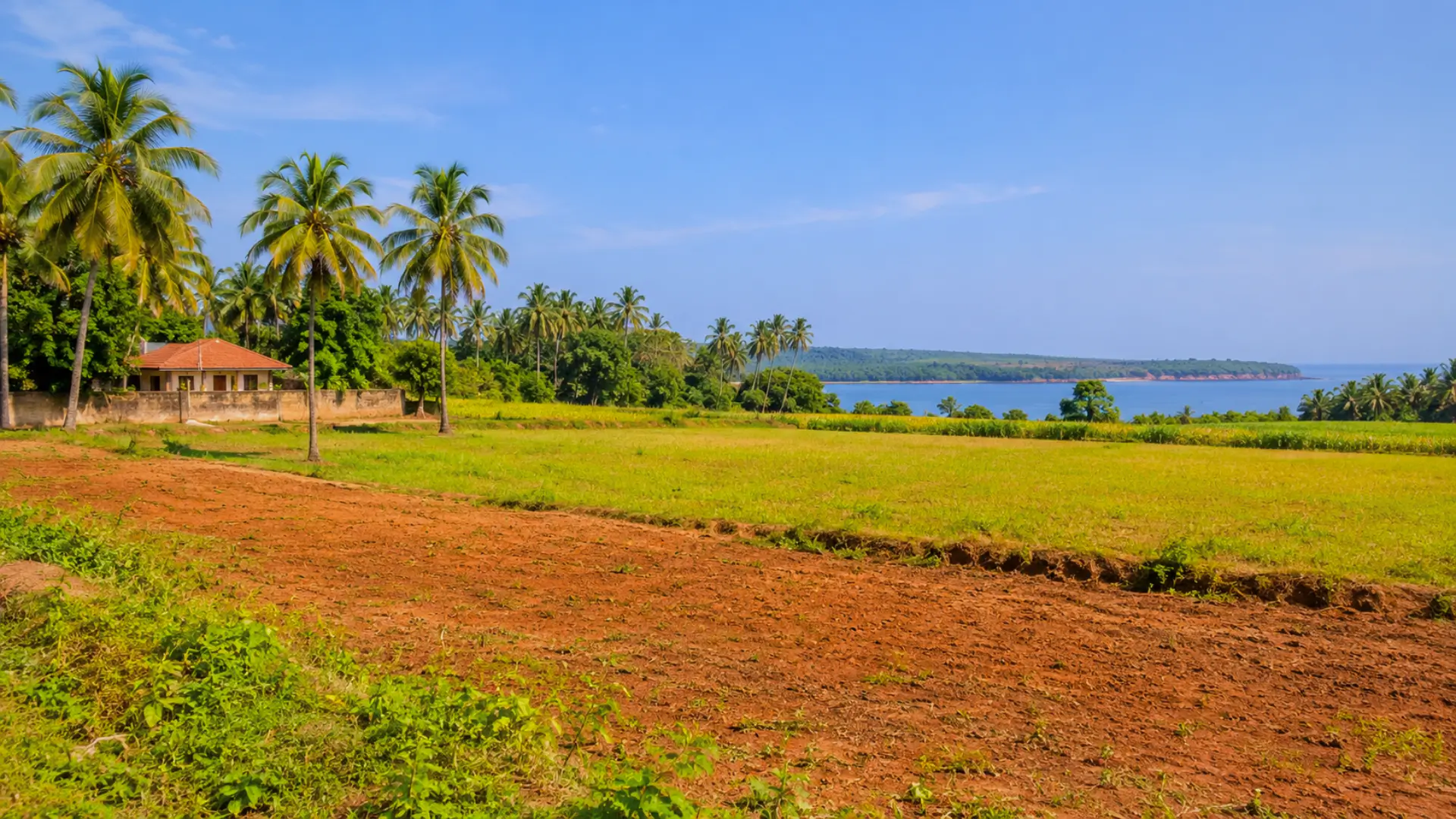
Some people don’t want a flat with a sea view. They want space: a house with trees around it, a kitchen garden, mangoes in season, and mornings that start with birdsong instead of traffic. On the Konkan coast, that kind of life is possible, and it’s the idea behind NA plots for farmland living in Sindhudurg.
But the phrase needs unpacking, because “farmland” and “NA” sound like opposites. Here’s what farmland living actually means, how it differs from owning agricultural land, who it suits, and what to check before you commit.
Important: “Farmland living” describes a way of living, not the legal classification of a property. NA stands for non-agricultural. An NA plot is land that is permitted for residential construction, not land classified for farming. Always check the actual classification of any property you’re considering.
What Does “Farmland Living” Mean on an NA Plot?
It means a home set in generous green space, with the look and feel of a farm-style property: fruit trees, a kitchen garden, herbal beds, open sky, and room to breathe. It’s a lifestyle choice, not a farming business.
The plot itself, in legal terms, is a different matter. In Maharashtra, agricultural land generally has to be converted to non-agricultural use before a home can legally be built on it, and that’s what NA means. So when a project talks about farmland living on NA plots, the sensible reading is: a plot where you can build a home, in a setting designed around greenery and space. Our guide to what NA conversion means in Maharashtra explains the legal side, including the 2025-26 reform.
Why Farmland Living in Sindhudurg Appeals to Homebuyers
Sindhudurg already has an agricultural rhythm running through it, which is part of why farm-style living feels natural here rather than staged. Devgad is known for its Alphonso mangoes, with the season running roughly from March to May. Vengurla is surrounded by cashew plantations and is known for kokum and cashew products in its market. Malvani cuisine is built around coconut and kokum. Add beaches within a short drive, and you get a combination that’s hard to find elsewhere: orchards and sea in the same day.
If you’re weighing how each coastal town differs, our guide to vacation homes on the Konkan coast breaks it down, and our guide to things to do in Sindhudurg shows what’s on your doorstep.
NA Plot vs Agricultural Land in Maharashtra: Key Differences
This is the most important section of this article, so it’s worth reading slowly.
An NA plot is not agricultural land. Agricultural land is classified for farming. An NA plot has been, or is to be, converted to non-agricultural use so that a home can be built. Maharashtra’s rules on this changed recently: an amendment notified on 31 December 2025 removed the separate Collector’s permission where the use is allowed under the area’s plan, and replaced the annual NA tax with a one-time premium. The details are in our NA conversion guide.
Check what “NA” means in each listing. Listings use phrases like “NA ready,” “NA included,” “NA at additional cost,” or “non-convertible,” and they mean different things. For example, Zinoha’s own listing for fabodé shows NA conversion as an additional cost, which means conversion isn’t included in the purchase price. That’s useful to know, and it’s exactly the kind of detail to clarify: what the property’s status is at registration, what conversion involves, who pays for it, and when.
For NRIs, the classification can be a legal question. Under the RBI’s Master Direction on acquisition of immovable property, NRIs and OCIs can purchase immovable property in India other than agricultural land, plantation property, and farm houses. “Farmland living” is a lifestyle description and doesn’t change this. If you’re an NRI, confirm the property’s exact classification at the time of purchase, and for NRIs and OCIs, the property’s actual legal classification and intended use are what matter, not simply its marketing description. Have an independent property lawyer verify that the land qualifies as residential property and does not fall within the restricted categories under FEMA. Our NRI’s guide to buying a villa in Sindhudurg covers the broader process.
| Factor | NA Plot | Agricultural Land |
| Classification | Non-agricultural | Agricultural |
| Residential construction | Subject to applicable permissions | Requires applicable land-use conversion/permissions |
| Gardening | Subject to permitted use | Subject to agricultural land-use rules |
| Commercial farming | Not automatically permitted | Subject to applicable agricultural rules |
| NRI purchase | Generally permitted if legally residential and other conditions are met | Restricted under FEMA rules |
What Can You Grow and Build on an NA Plot?
In practical terms, the lifestyle part is straightforward:
- Build a home. In communities like this, you typically design and build your own house after purchase. Zinoha’s homepage says prefabricated houses are available at an additional cost, which can shorten the build.
- Grow a garden. Fruit trees, a kitchen garden, and herbal beds are a natural part of farm-style living. Zinoha’s pages say each plot comes with a selection of fruit, berry, and herbal plants.
- Enjoy the space. Larger plots leave room for a veranda, outdoor seating, and a proper garden rather than a token strip of lawn.
What you shouldn’t assume is that an NA plot lets you run a commercial farm. Permitted use depends on the property’s classification, its zone, and the approvals attached to it, so if farming for income is part of your plan, ask about it specifically before buying.
How to Design a Farm-Style Home in the Konkan
The Konkan climate is warm and humid, with a serious monsoon, so a farm-style home here is designed around water and air:
- Deep verandas and cross-ventilation to stay comfortable through the humid months.
- A raised plinth and good drainage, because heavy monsoon rain finds every low point.
- Rainwater harvesting, which makes sense where rainfall is high and a garden needs water through the dry months.
- Native, climate-suited trees such as mango, coconut, kokum, and jackfruit, which tend to do better than delicate imports.
- Power backup and a reliable water source, which matter more when you’re running a garden and a home.
If the plots in a community don’t have internal boundary walls, as in Zinoha’s “No Boundary, No Gate” concept for its plotted communities, plan your garden layout and privacy accordingly, using planting and landscaping rather than walls.
Looking After a Garden When You’re Not There
The part many buyers underestimate is upkeep. Gardens in the Konkan grow fast in the monsoon and need watering in summer, which is a lot to manage from another city. Before you buy, ask who can look after the garden when you’re away, whether the community offers maintenance services, and what they cover. A managed, gated community with 24×7 CCTV surveillance, which Zinoha lists for its societies, handles security, but gardening and upkeep arrangements are worth confirming separately.
If you’re deciding how often you’d actually use a place like this, our guide to Sindhudurg as a weekend getaway and our honest look at living in Sindhudurg full-time can help.
Who Is Farmland Living For?
It tends to suit people who want space and greenery, families who’d like children to grow up around trees and a garden, retirees who enjoy gardening, remote workers looking for a calmer base, and anyone who wants a vacation home with more breathing room than an apartment offers.
It may not suit people who want a finished home from day one, who would find managing a construction project stressful, who can’t arrange upkeep when they’re away, or who are looking to farm commercially. If you’d prefer a ready-built home, a sea-facing villa in Maharashtra is a different route.
Things to Check Before Buying NA Plots in Sindhudurg
- The exact NA status, in writing. Ask what has been completed, what’s still pending, and what the conversion costs and who pays.
- Property classification and approvals: Obtain the existing land records, applicable development permission or building plan approval, relevant conversion records and premium payment documents, as applicable to the property’s history and legal status.
- Clear title and a lawyer’s independent verification of ownership.
- RERA. Whether the project is required to be registered and, if so, that it is.
- Plot size, layout, and boundaries, and how the plot is marked out on the ground.
- Access, water, power, and drainage to the specific plot.
- Coastal rules if the property is close to the sea.
- Upkeep arrangements for common areas and for your garden.
- For NRIs, the classification at the time of purchase and any plantation or farm house question.
What This Looks Like at Zinoha
At Zinoha, NA plots for farmland living in Sindhudurg are offered at fabodé. According to the current listing, the plots are large, at 1,112 sq. m. (about 1,330 sq. yd.), with five beaches within 9 to 21 minutes, immediate registration, optional clubhouse membership, and telephone, internet, and DTH connections. The plots have no internal boundary, and each plot comes with a selection of fruit, berry, and herbal plants. As noted above, the listing shows NA conversion as an additional cost, so confirm the current status and what it involves directly before deciding.
Details can change, so verify them with us for the specific plot you’re considering. To compare other formats, you can browse our gated villas near Goa, and our Sindhudurg real estate market research hub covers the district’s broader picture.
FAQs
What does “farmland living” mean
It describes a lifestyle: a home set in generous green space with fruit trees, a garden, and a farm-style feel. It isn’t a legal classification and doesn’t mean the property is agricultural land.
Is an NA plot the same as agricultural land?
No. NA means non-agricultural. An NA plot has been, or is to be, converted so a home can be built. Agricultural land is classified for farming.
Can I farm on an NA plot?
You can usually garden and grow fruit trees as part of the lifestyle, but commercial farming is a different matter. Permitted use depends on the property’s classification, zone, and approvals, so ask before you buy.
Can NRIs buy an NA plot for farmland living?
NRIs and OCIs can purchase immovable property in India other than agricultural land, plantation property, and farm houses. Because classification matters, confirm the exact status in writing and take legal advice before buying.
Is NA conversion included at fabodé?
According to Zinoha’s current listing, NA conversion is shown as an additional cost. Confirm the current status and what it involves directly with the project before deciding.
How far is fabodé from the beaches?
The current listing shows five beaches within 9 to 21 minutes. Confirm the actual route and travel time for the plot you’re considering.
What grows well in Sindhudurg’s climate?
Native fruit trees such as mango, coconut, kokum, cashew, and jackfruit suit the Konkan climate, along with herbs and seasonal vegetables. A local horticulturist can advise on what suits a specific site.
This article is for general information only and isn’t legal or financial advice. Land classification, permitted use, and foreign exchange rules depend on the specific property, so get independent legal advice before you buy.
Sources: Zinoha homepage and project listings, RBI Master Direction on acquisition of immovable property, Maharashtra Tourism Department, Sindhudurg, Mondaq, sanad requirement removed for land conversion.